JIGGER JOHNSON has been called the last of a colorful breed of loggers - - that race of men who cut a swath of timber from Maine to Oregon and yelled like crazed devils every spring when the drive was in and they were released from the savage woods for a few days to pound the bars. His life, and especially his death at age 65 in 1935, symbolized the end of an era. As writer Stewart Holbrook noted in his book on loggers, "Holy Old Mackinaw," "The professors would term Jigger’s brief story an epitome, and so it was. "In tribute to one of the 20th century's most colorful characters, the U.S. Forest Service’s Saco Ranger District on the Kancamagus Highway (Route 112) in Conway is featuring an exhibit on the late former USFS employee beginning in mid-January.The late Bob Monahan, who died in 1994 at age 86, was a former Dartmouth College forester and longtime friend of the Jigger. Monahan claimed that the nickname, "Jigger," could be attributed to Johnson’s small stature, as he was only five-foot-six, and never weighed more than 160 pounds. "All of him was steel-spring muscle, except his head, which contained brains aplenty”; said Monahan, a founding member of the 1932 Mount Washington Observatory and a member of the summit crew that year. "Those who witnessed him in battle still recall his courage and ferocious attack — no matter the odds against him”. There, by the grace of God and assorted genes, walked a man among men. "I can run faster, jump higher, squat lower, move sideways quicker, and spit further than any son-of-a-bitch in camp," is the way Johnson used to put it upon his arrival at a new logging operation. Others might add that he was the greatest drinking man’s he-man, blessed with a stomach lined with boilerplate. Jigger was tough even at the usually tender age of 12, a fact, which he quickly proved during a mealtime scuffle with a grown man twice his size upon his arrival at a logging camp. Conversation at dinner was forbidden, a custom, which was challenged by a new group of loggers who arrived in camp with heavy hangovers, just in time for supper.When one of them insisted on talking loudly at the table, Jigger dutifully told him to shut up, prompting the elder man to jump the boy and push him to the floor where he pounded him. Jigger hugged the big drunk close, set his keen young teeth into an ear, and hung on. When some of the crew pried the pair apart, a good hunk of the ear remained in Jigger’s mouth. According to the accounts of old loggers, he had few equals as a woodsman at a time when a man was judged by the smoothness of the scarf of his axe’s undercut. He could fell a tree uphill, downhill, with or against the wind, even so that upon falling it would drive a stake previously set in the ground. It was told that he would walk a felled spruce, barefoot, and kick off every knot from butt to top. Despite his considerable fighting skills, Jigger’s taut body bore the marks left by the stellcalks of opponent’s logging boots, injuries which he referred to as his "logger’s smallpox." That his face was free from such marks was attributed to the fear in which men held Jigger’s teeth.
Sometime in the fall of 1932 Jigger was trying to hitch a ride down to his favorite tavern in Portsmouth. Few cars passed him by in the great woods, but after two days of hitching, and sleeping overnight in a frozen ditch, a car driving Harold S. Vanderbilt to Bretton Woods kindly stopped. Jigger immediately struck Harold as a man with a keen mind, and Harold imparted in Jigger all he knew about the game of Contract Bridge, a game then in its infancy. Within a few months Jigger became adept enough at the game to win consistently, dazzling all with his card skills, his savage mountain brain tricking the clueless minds of seasoned players. But this was not enough for Jigger: he took the best parts of Vanderbilts’ pet system, the forcing club, and married it with super-light opening bids and dazzling psyches. “Presumed Fit” opening bids and even a “Forcing Pass” were part of his system, both uses of these bids pre-dating the “invention” of them decades later by others. He was unbeatable that summer of ’33. Sadly, Jigger’s lifestyle and alcohol consumption severely limited his tournament appearances for what was to be the rest of his life.
Jigger’s life came to a tragic and churlish end on a cold winter day in March 1935. Having sold a big lynx only a day or two before and consequently in funds, he’d headed into Conway to celebrate with his drinking cronies while his bounty receipts lasted. Remembering that state law required daily visits to traps, and realizing that he was a day or two overdue, Jigger hired what he still called a horse-less carriage and a driver to take him to a point off the West Side in Passaconaway where he could take off on snowshoes for his trap line. Moving along all too fast, the car slithered off the icy road and sideswiped a telephone pole just as Jigger had opened the door to jump out. All of the old-time loggers attending his funeral remarked that it was a hell of a way for the Jigger to get sluiced, Stewart Holbrook noted. He was buried in a pauper’s grave at North Conway Cemetery, according to David Emerson of the Conway Historical Society. Largely through the urging of Monahan and other friends, the U.S. Forest Service honored the great woodsman by naming a campground located on the Kancamaugus (sic) Highway after Jigger. It’s one way of remembering a man and a way of life whose time has long passed.
During October of 1993, two friends, Neill Currie and Tony Melucci, were exploring the Lost River on the Cancamagus highway in New Hampshire. They were friends through their love of Bridge, and were out leaf-peeping. Scrabbling around the many rocky “man holes” in the Lost River, Tony chanced upon a small silver locket wedged into a crack in the rock. It looked like it had been there for many, many years. Back in the light of day, they opened the locket, and carefully unfolded the delicate parchment within. Their hands trembled when they realized what was before them: the fabled “Lost System of Jigger Johnson”, which had been lost for sixty years, was detailed for the young pair of fledgling players. It took them many months to grasp the full intricacies of “The System for the ages”, as Edgar Kaplan once called it reverently, but their addled brains finally worked out some of the arcane knowledge contained within that silver locket. Months later, when the two had finally eked out enough of Jiggers brilliance to play a dull version of it themselves, hacking in local Bridge Clubs, Neill would invariably make some bone-headed bid, costing the pair many matchpoints. Tony would sigh, and gently ask his friend “Now, what would Jigger have done?”
And thus, “The Lost System” lived on to fight another day.
For System details, please read here.
My BBO User Name is jota981 if you have questions, or, I may have enabled comments on this blog.
Wednesday, February 23, 2011
Sunday, December 05, 2010


Wednesday, November 03, 2010
Rauber...
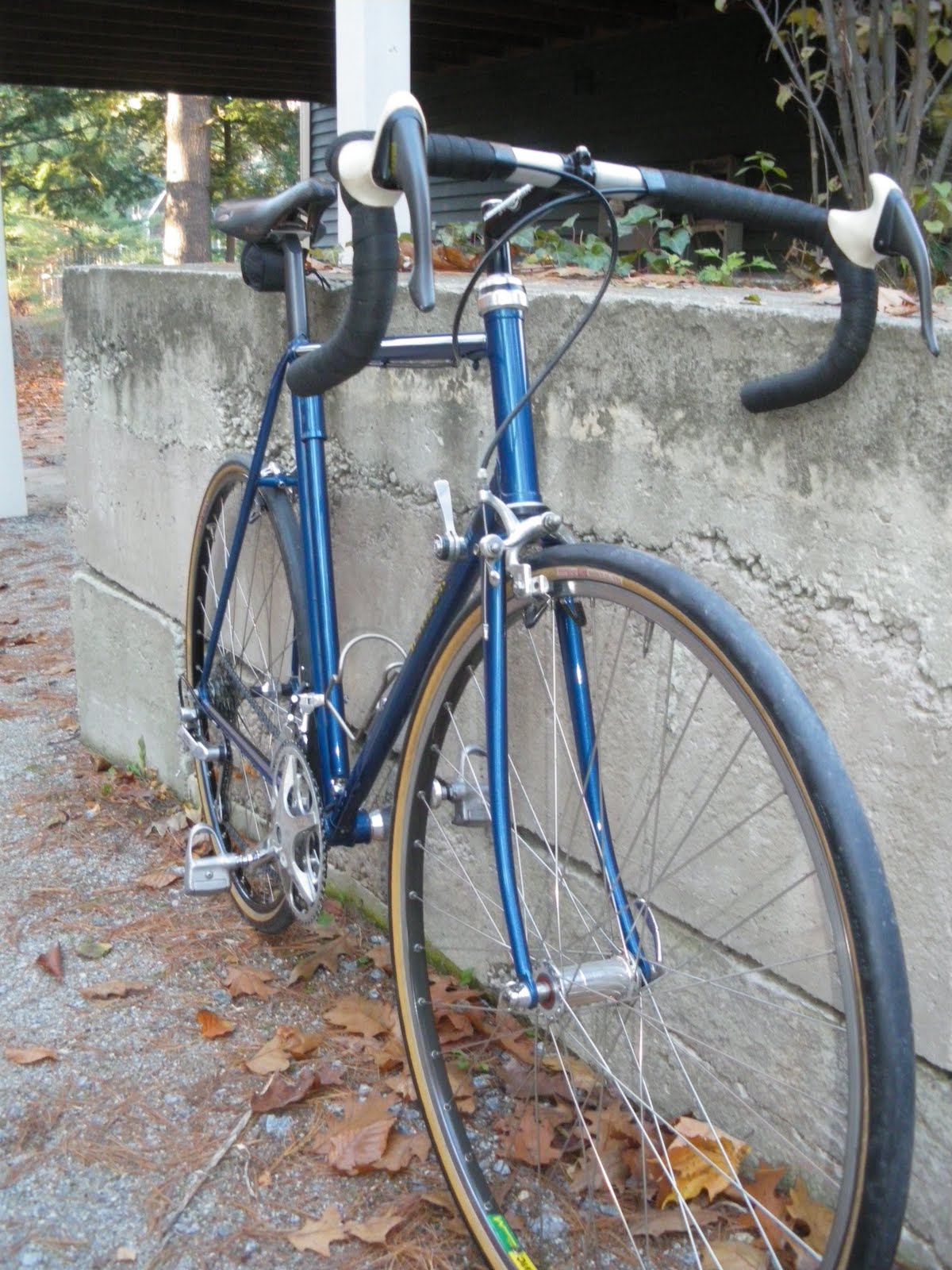

Probably Reynolds 531 or similar, rides just like it. Beautiful heart-shaped cutouts in lugs. Paint-matched Silca framepump. Very nice ride, stable yet fast, takes up to a 700c x 35mm tire. Has "Greg Hindley" in tasteful gold script on toptube.
Monday, October 18, 2010
Babbage, before his time...
A British technologist has started a non-profit campaign to eventually build a working copy of Charles Babbage's Enalytical Engine. Help him out:

Thursday, December 03, 2009
One of fifty...

I owned this bike since it was one month old in 1987. It's a Fuso MTB, made by Dave Moulton, who has since retired. There are a few more pics here. The first pic is not of my bike however, mine's a 22 inch frame. The paint job etc are identical though.
Friday, October 23, 2009
Thursday, August 27, 2009
Ecology week...

In the space for one car fit 42 Bromptons...and they are stacked just one deep. Imagine how many would fit if they were to keep stacking them to the height of the adjacent vehicles.
Monday, August 24, 2009

Monday, December 01, 2008
Stumbleupon.com


Had some time free today, and finally decided to explore the amazing resource that stumbleupon.com provides. Here's just a few images.
Monday, November 24, 2008
First computer hard drive.

September 4, 1956: The launch of the IBM 305 RAMAC
Ramac The first hard drive arrived in the 305 RAMAC, meaning that the computer could store data digitally. Not much data, though – the one-ton machine seen in an archive photograph being loaded into an aircraft on a forklift truck, could store a little less than 5MB of information. Thumb-sized USB drives will now store more than a thousand times that quantity of data.
- From the Times Archive, 1958: IBM announces the RAMAC’s first visit to the UK in 1958
Saturday, October 25, 2008
Ritchey Commando, circa 1987, Deore XT.


Purchased from an ebay seller a few years ago. The photo's were very bad, the sellers feedback was perfect, I took a small chance that paid off. When I got the bike I couldn't believe the amazing, time capsule condition it was (still is) in !! All XT, except for a few nice Ritchey components.
circa 1991 Goat with night-sky camo, eclectic components.


Built this as a tourer as soon as I had it made for me by the guys at Chico. It has done many thousands of miles. Sharp-eyed individuals may note that the 6 speed shifters actually drive 7 cogs on the rear, which are 6 speed spaced!! I custom made the 2 largest cogs on the Shimano Dura-Ace *freewheel* to achieve the effect. At one time I had a Quad Ring adapter up front as well, giving me a range from 16 through 46 up front, and 13 through 28 in the back. I actually needed that super low gear just once, when climbing a hill near Dartmoor, England. That was about 6 years ago, when doing the End to End, loaded touring.
Monday, July 02, 2007
What's on your bicycle...


Culled from the nether regions of the Internet for your viewing pleasure. Just when you think you've seen it all, or that bicycles are a mature/stagnant industry with no innovation, comes something that blows you away.
Tuesday, June 19, 2007
Thumbshifter renovation....

So, way back in the day, when the Buffmeister was almost a young man, he worked as a mechanic. Riders would come in with bikes that they'd crashed, and often the casualty was a broken thumb-shifter. They usually broke at the weakest point, which is at the end of the plastic grip that one pushes with their thumb. Some people would have damage to the plastic cap that covers the internals, Shimano did sell replacement caps, but there were many varieties, two different "hands" of them, and few stores carried that part. Shimano only sold thumb-shifters in pairs, of course, and so customers would "donate" one perfectly good, and one broken thumb-shifter to me after replacing both. Pretty soon I had a small box of broken shifters, and I figured out a way of repairing them.
Here's the method I devised.
1...Where the shifter usually broke, flatten the aluminum square with a flat file.
2...Drill a blind hole into the remaining peg, not so far as you drill into the internals and totally bugger the shifter ;-(
3...Screw in a sheet metal screw of sufficient length that when fully in you have about one inch sticking out the thumb-shifter. Screw it in with permanent locktite or 5 minute epoxy on the threads.
4...Wait for it to set. Cut off the head of the screw. grind a point where the head was.
5...Drill a piece of dowel or exotic wood with a blind hole.
6...Fill the hole with epoxy and screw the dowel tightly on the screw. Fill all cracks, imperfections with epoxy.
7...Let it set, overnight.
8...Sand the dowel to shape, decorate/embellish to your liking. In the pic, mine are decorated with copper pipe, only problem is I spend more time buffing them than riding the bike.
Using the above method, I have never had a failure of a repaired thumb-shifter in two decades now.
Also, if the top cap is damaged, you can simply epoxy quarters onto the top, covering up the ugliness. Indian head coins look the coolest.
Lesser known thumb-shifter facts:
1...There's a hidden click at the end of the range. You can make 6 speed shifters work over 7 (six-speed-spaced) cogs, for example. Likewise a 7 speed thumbie will work over 8 cogs if they are spaced as a 7 speed. I often use the inner cog from a Ritchey 2x9 kit to give me a 33 tooth inner cog, with lower overall cassette width (less dish) than using a "standard" cog. Sometimes a small shim is needed for a clean shift.
2...You can adjust the firmness of the indexing: remove the shifter. From underneath unscrew the small #1 philips screw and pop off the top cap. The nut you see on top adjusts the tension(beware it's a left-hand thread: "unscrew" to increase tension). It indexes itself, so a couple of "clicks" is usually enough to change the setting.
3...You can disassemble and rebuild the thumb-shifters. Follow #2 as above, then back off that nut till the shifter internals come apart. Clean and re-lube, reassemble. I don't recommend this, all I have ever need to do in 20 years is flush with WD40, then dribble in some 30W oil, with no disassembly.
Monday, June 18, 2007
Altoids tin toolkit

Here's the packed and unpacked versions of my Altoids tin toolkit. I carry a tube, patchkit and pump/CO2 as well.
Allen wrenches, a full run from 2 to 8mm.
Wrench Force wrench with 8mm and 10mm and caplifter.
2 tire levers, one has Duct tape wrapped around it.
A shimano wrench that fits 9mm, crank dustcaps, and chainring bolt rears.
WTB chaintool with bailingwire wrapped around handle.
Small half-round file.
Short length of hacksaw blade.
SeberTech M4 tool, pliers and wire cutters will cut 2mm brake cable, also has blade, bottle opener, tweezers, small file, phillips and straight screwdrivers.
3 Topeak dog-bone spoke wrenches cover all common sizes.
Presta to Schraeder valve adapter.
Shimano chain pin.
Master link for chain.
Spare chainlink.
Spare chainring bolt.
Spare waterbottle bolt and nut.
Spare cleat bolt.
A wet-nap to clean up with afterwards.
It's a tight fit, very little else could be packed inside the tin.


Tuesday, May 29, 2007
Extended tour toolkit
This kit is used for longer trips, when I want to be able to fix almost anything short of headset or bottom bracket replacement. It's based on one of the modifiable small tackle boxes that fishermen use. Case costs about $1.50. Here's a pic of the closed case:

And here's a pic of it in its open state:
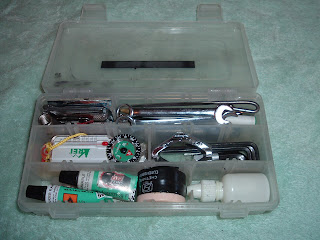
And this is what's in it:
From top right corner, clockwise...
2 tire levers, shortened, with duct tape.
Shortened ballpoint pen (marks puncture location on tube also).
Half-round file.
Craftsman ignition wrenches, 8, 9, 10mm.
3.5" adjustable wrench.
Piece of a hacksaw blade.
Allens: 6, 5, 4, 3, 2.5, 2.
8mm to 6mm allen adapter.
Spare chain link.
Wrench Force 4-way spoke wrench.
Botle of chain lube (Eye drop containers are very useful for this purpose).
Lip Balm container filled with grease.
Matches sealed in plastic.
2 strips of double-sided tape.
Small Compass and Thermometer/Windchill gauge.
Emergency whistle.
2 tubes of patch glue.
Fiberfix emergency spoke.
Topeak chaintool.
SeberTech minipliers, wire cutters will cut 2mm brake cable, assorted blades, tweezers, file.
Assorted patches and sandpaper.
Not shown:
14mm socket, ground so the crescent wrench will fit it.
Assorted essential nuts, bolts and various spare parts....Chainring bolt, waterbottle bolt,cleat bolt, Rear derailleur pulley and bolt, chain masterlink.
I also have a small pack which contains:
1 full-length brake and derailleur cable.
A few zip ties.
Bailing wire.
Superglue.
Wetnap wipes.
A pair of latex gloves.
A small rag.
A few cable end caps.
Not enough tooltalk for you? Check out the Altoids tin toolkit.

And here's a pic of it in its open state:

And this is what's in it:

From top right corner, clockwise...
2 tire levers, shortened, with duct tape.
Shortened ballpoint pen (marks puncture location on tube also).
Half-round file.
Craftsman ignition wrenches, 8, 9, 10mm.
3.5" adjustable wrench.
Piece of a hacksaw blade.
Allens: 6, 5, 4, 3, 2.5, 2.
8mm to 6mm allen adapter.
Spare chain link.
Wrench Force 4-way spoke wrench.
Botle of chain lube (Eye drop containers are very useful for this purpose).
Lip Balm container filled with grease.
Matches sealed in plastic.
2 strips of double-sided tape.
Small Compass and Thermometer/Windchill gauge.
Emergency whistle.
2 tubes of patch glue.
Fiberfix emergency spoke.
Topeak chaintool.
SeberTech minipliers, wire cutters will cut 2mm brake cable, assorted blades, tweezers, file.
Assorted patches and sandpaper.
Not shown:
14mm socket, ground so the crescent wrench will fit it.
Assorted essential nuts, bolts and various spare parts....Chainring bolt, waterbottle bolt,cleat bolt, Rear derailleur pulley and bolt, chain masterlink.
I also have a small pack which contains:
1 full-length brake and derailleur cable.
A few zip ties.
Bailing wire.
Superglue.
Wetnap wipes.
A pair of latex gloves.
A small rag.
A few cable end caps.
Not enough tooltalk for you? Check out the Altoids tin toolkit.
Monday, February 26, 2007
Technorati...
Technorati...
It's a new word, and it basically means publicity. So, with that shameless plug, here's the required Blog entry to make everyone happy.
We all want our 15 minutes of fame, right?
Technorati Profile
It's a new word, and it basically means publicity. So, with that shameless plug, here's the required Blog entry to make everyone happy.
We all want our 15 minutes of fame, right?
Technorati Profile
Subscribe to:
Posts (Atom)